


A Fine Art Collectible Limited Edition 3D Facsimile
THE RECONSTRUCTION . . . of the 2016 prototype
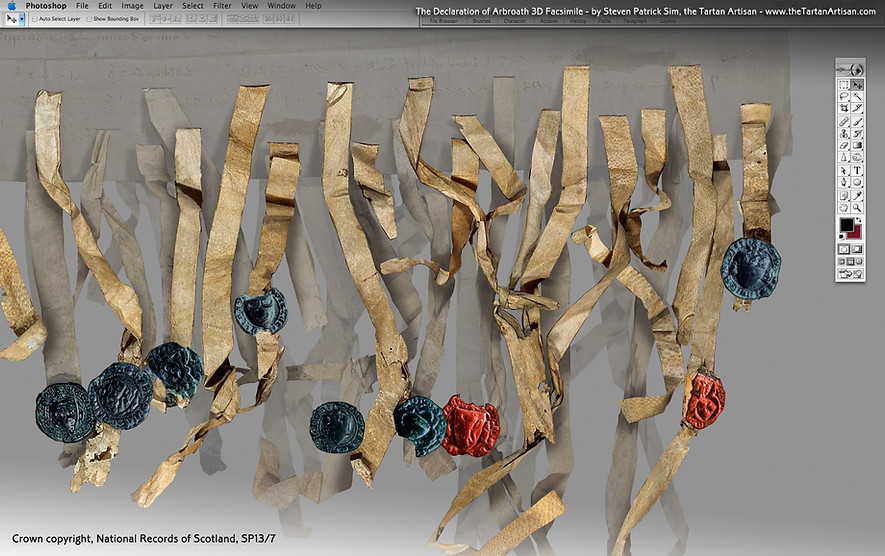
Digitally disassembled
— and cut by laser!
Produced after countless hours of work, the original 2016 3D facsimile prototype was created from a high-resolution image of the surviving Declaration of Arbroath.
The two-dimensional image was digitally deconstructed into individual layers, with the separations made as accurately as possible and kept true to the source image.
During this process, one of the major challenges was to reconstruct the hidden or missing elements by careful extrapolation — including areas that would sit underneath the uppermost visible layers — so that each printable structure could be completed.
These separated layers were then produced as archival fine-art giclée printed sections on 255gsm acid-free Somerset® Enhanced Radiant White Velvet fine-art paper.
The printed sections were then delivered to a laser-cutting specialist in Stirlingshire, Scotland, where the individual components were cut out by laser beam with millimetre accuracy.

The Declaration of Arbroath 3D replica, the digital disassembly of the fine art limited edition facsimile, during the pre-development phase... by Steven Patrick Sim, the Tartan Artisan

The Declaration of Arbroath 3D replica, the digital disassembly of the fine art limited edition facsimile, during the pre-development phase... by Steven Patrick Sim, the Tartan Artisan

The Declaration of Arbroath 3D replica, the digital disassembly of the fine art limited edition facsimile, during the pre-development phase... by Steven Patrick Sim, the Tartan Artisan
The Declaration of Arbroath 3D replica, the digital disassembly of the fine art limited edition facsimile, during the pre-development phase... by Steven Patrick Sim, the Tartan Artisan
 |  |  |
|---|---|---|
 |  |  |
 |  |  |
 |  |  |
 |  |  |
 |  |  |
 |  |  |
 |  |  |
 |  |  |


Each part assembled by hand

Work then began on the assembly of the first prototype, with the intricate printed and laser-cut separations reassembled by hand, piece by piece, with care and accuracy.
The seal tags were slotted and permanently mounted through the main section of the facsimile — the letter itself.
Each seal tag was individually shaped to introduce form and three-dimensional movement, helping the positioning resemble the original surviving document, but now interpreted in physical depth.
The Seals
— printed giclées, in miniature
The document’s surviving seals were also created with a fine level of detail, producing a three-dimensional illusion within the finished prototype.
The 19 surviving seals — 8 red and 11 green — were individually printed as high-resolution miniature fine-art giclée reproductions from photographic images of the seals.
These miniature prints were then built up using archival materials to add a degree of three-dimensional realism. Each was permanently adhered to acid-free cotton board, trimmed and sculpted by hand, then embellished on the reverse with fine-art clay.
After attachment, the printed and embellished seals were hand-painted with fine-art acrylics, blending shades of red and green. They were then protected with multiple coats of conservation gloss varnish, creating a subtle reflective quality that catches the light.
The result was a convincing wax-like effect in the art piece, and the first prototype was complete.
The seals were accurately positioned and permanently attached to the seal tags of the facsimile.

One of the first prototypes produced, before embellishment of the seals

Crown copyright, National Records of Scotland, SP13/7
Note: images on this page show the development of one of the early prototypes in 2016, before embellishment of the printed giclée seals for this particular piece.